

Spring Speakers
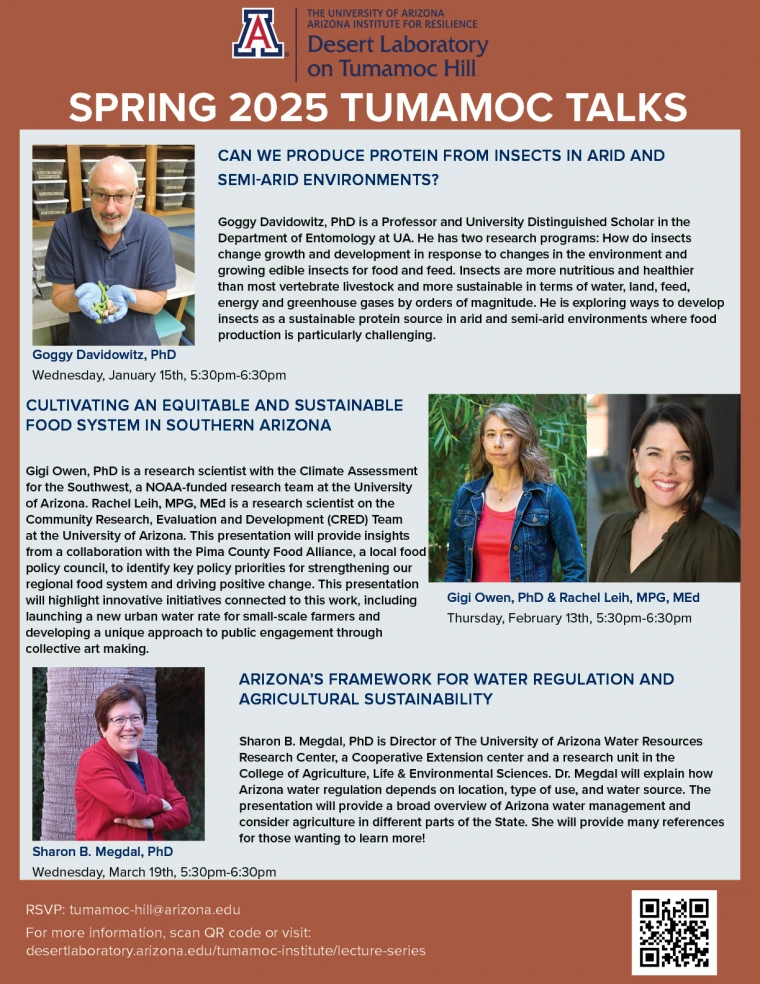
Goggy Davidowitz is a Professor and University Distinguished Scholar in the Department of Entomology at UA. He has two research programs, how do insects change growth and development in response to changes in the environment and growing edible insects for food and feed. Insects are more nutritious and healthier than most vertebrate livestock and more sustainable in terms of water, land, feed, energy and greenhouse gases by orders of magnitude. We are exploring ways to develop insects as a sustainable protein source in arid and semi-arid environments where food production is particularly challenging.
Gigi Owen is a research scientist with the Climate Assessment for the Southwest, a NOAA-funded research team at the University of Arizona. She is a qualitative human geographer with a background in political ecology, science and technology studies, and research evaluation. Her recent work involves partnering with a local food policy council to investigate societal, economic, and climate risk in southern Arizona’s local food system to support local planning and policymaking.
Rachel Leih (she/her) is a research scientist on the Community Research, Evaluation and Development (CRED) Team at the University of Arizona, a team focused on conducting community-based research and evaluation that promotes the health and well-being of children, youth, and families throughout Arizona and the Southwest. Rachel has a background in psychology, education, and public health, and is particularly interested in opportunities to center capacity-building and community engagement in research and evaluation.
Sharon B. Megdal, Ph.D. is Director of The University of Arizona Water Resources Research Center (WRRC), a Cooperative Extension center and a research unit in the College of Agriculture, Life & Environmental Sciences. Other primary titles are Professor and Specialist in the Department of Environmental Science, C.W. & Modene Neely Endowed Professor, and Distinguished Outreach Professor.
Sharon Megdal bridges the academic, practitioner, and civil society communities through water policy and management research, education, and engagement programs. The geographic scope of Dr. Megdal’s work ranges from local to international. Applied research projects include analysis of water management, policy, and governance in water-scarce regions, groundwater recharge, and transboundary aquifer assessment.